
Private companies can now run a price race on Tendergate. While the race runs, suppliers can lower their price, and each one sees whether their bid is currently the best. The buyer decides what "best" means: the lowest price, or the highest combined score for quality and price.
Suppliers could already replace an open bid on Tendergate before the deadline, but they never knew where they stood. The price race adds that signal and a set of rules around it. We took the rules from Article 35 of the EU procurement directive, 2014/24/EU, which sets out how public buyers run electronic auctions. A public buyer may hold one only after a full evaluation of every tender, and only when the specification is precise. Bidders must never learn who the other bidders are. When the award weighs quality, the formula that re-ranks the bids has to include the weight of every criterion. Private companies don't have to follow any of this, and we used it anyway.
1. One stage: the lowest price wins
For a routine purchase with a clear specification, such as office furniture or a cleaning contract, the buyer publishes a tender and switches the price race on. From publication until the deadline, suppliers can lower their price as often as they like, within a few rules.
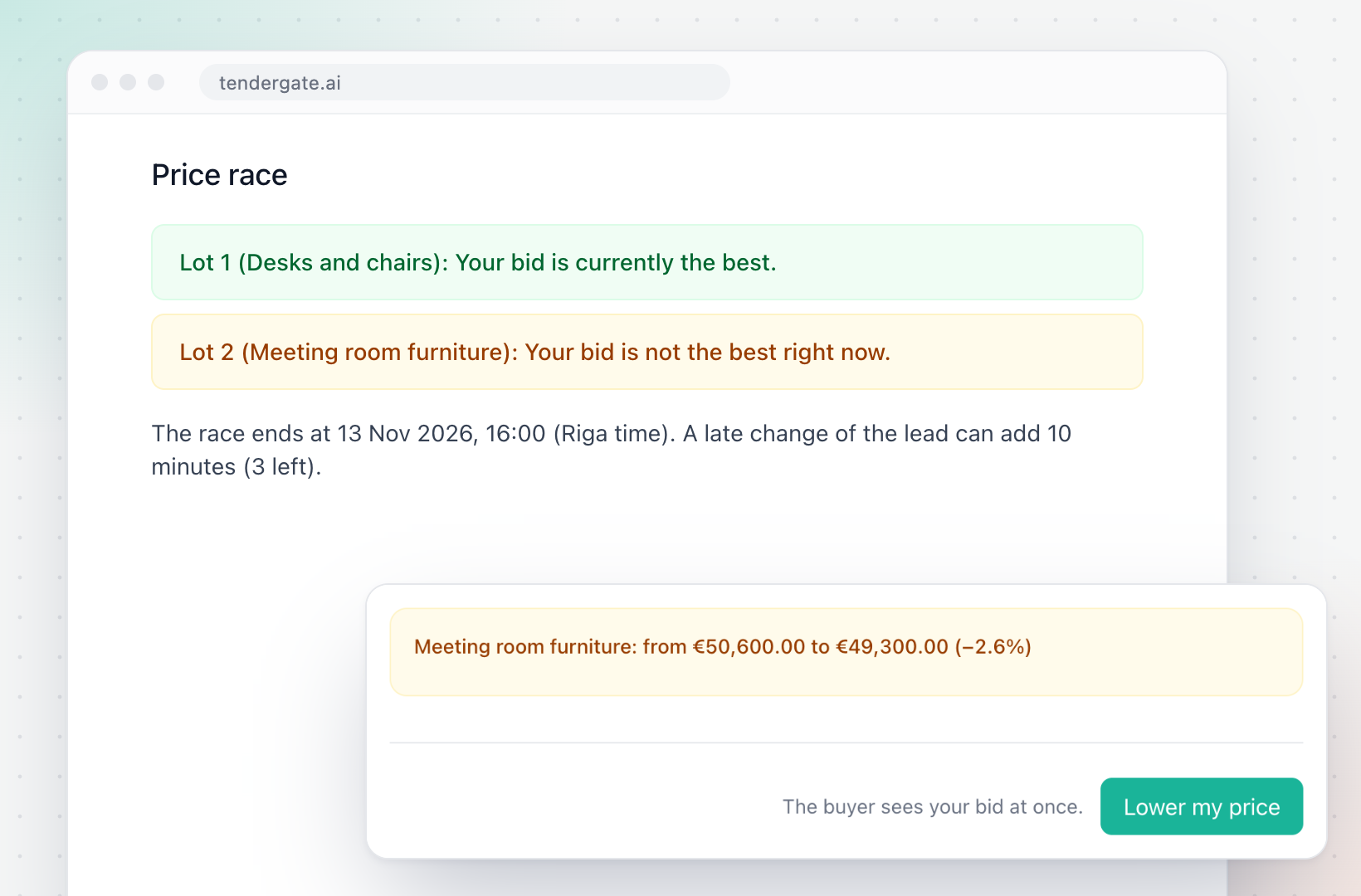
For each lot, the supplier sees one fact: whether their bid is currently the best. Demo data.
Each new price must be at least 2% below the supplier's own previous price. The buyer can set a different step, down to 1%. A supplier waits 60 seconds between rebids. Prices only go down, and a bid can't be withdrawn while the race runs. If the lead changes in the last 10 minutes, the race gets 10 more minutes, up to three times, so the other suppliers always have time to answer a late bid.
The buyer follows the race on one board: the leader of each lot, every price and rebid, and the saving against the estimate.
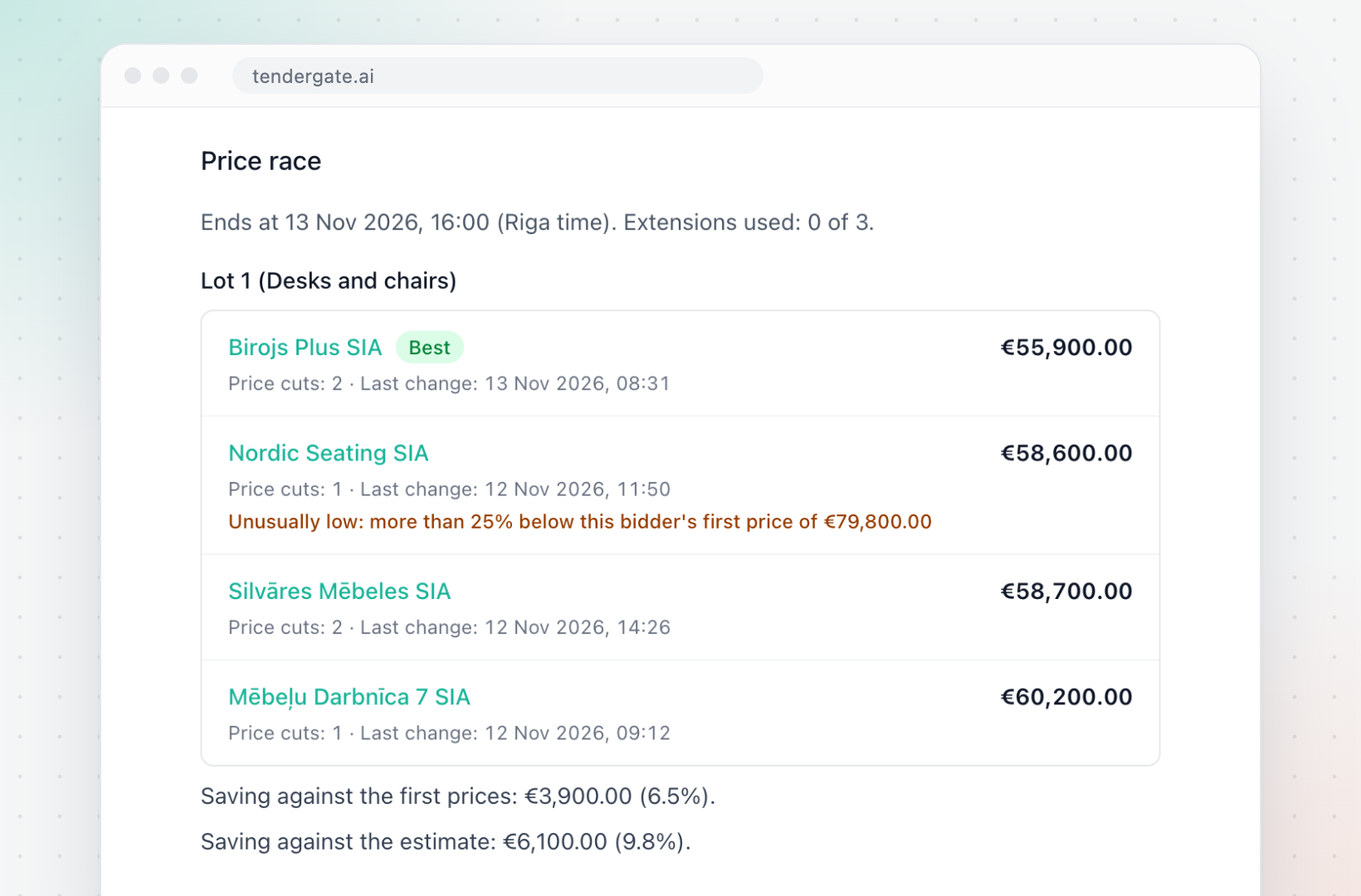
The buyer sees every price, the rebids and the saving as the race runs. Demo data.
2. Two stages: quality first, then price
A race on price suits goods where any supplier's product will do. For a service, a project or equipment with different running costs, it rewards the cheapest offer whatever its quality. We've written about the lowest-price trap and why the cheapest option is rarely the cheapest. In Latvian public tenders, price decides roughly 86% of the awards, including many that say they weigh quality.
For these purchases the price race has a best-value mode with two stages. In stage 1, suppliers send full proposals. Tendergate's AI proposes quality points against the tender's own criteria, and the evaluators confirm or change each score. The buyer doesn't see the prices during this stage, so no number pulls on the quality scores. The buyer then picks the qualified bidders, and their quality scores are frozen.
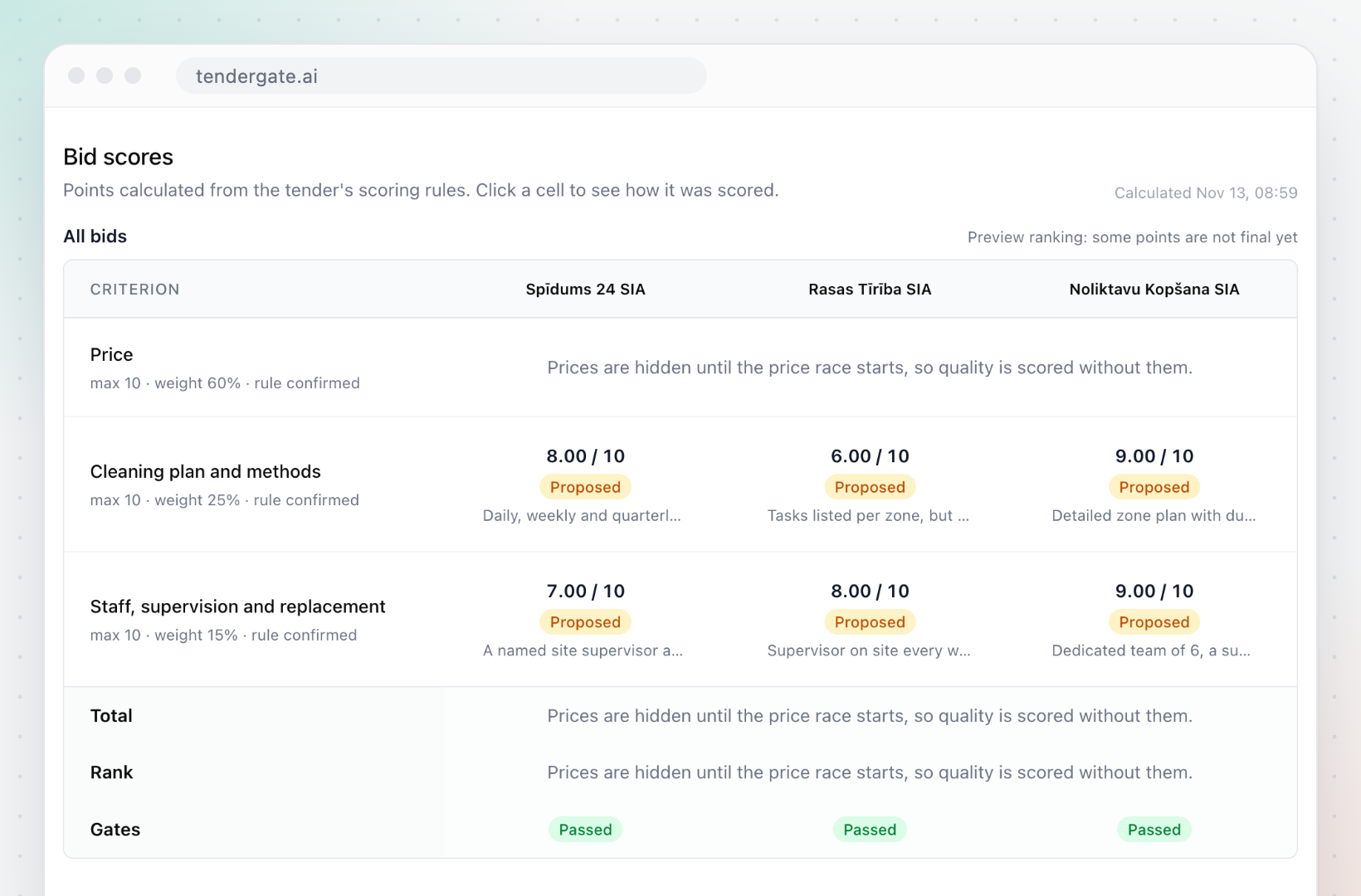
The AI proposes points for each quality criterion; the evaluators decide. Prices stay hidden until the race starts. Demo data.
Stage 2 is a timed price race. The leader is the bid with the highest total: the frozen quality score plus the price points from the tender's scoring rule. A supplier with a stronger proposal can stay ahead at a higher price. The buyer can also skip the race and award on the stage 1 scores.
3. What bidders see
The directive requires public buyers to tell bidders at least their relative ranking. We show less. Each supplier sees only whether their bid currently leads, and never another supplier's price, rank, score or name, during the race or after the award. A supplier who knows its rank tends to price against the bid just above it. A supplier who only knows whether it leads has one decision to make: cut or stay.
The board suggests the leader, and the award stays with the buyer. If the buyer picks someone else, Tendergate asks for the reason and keeps it in the tender log. A price 30% or more under the estimate, or more than 25% under the supplier's own first price, gets a flag so the buyer checks it before the award. Public buyers have a similar duty for abnormally low tenders. Bidders learn the outcome only if the buyer chooses to tell them, and then only "selected" or "not selected".
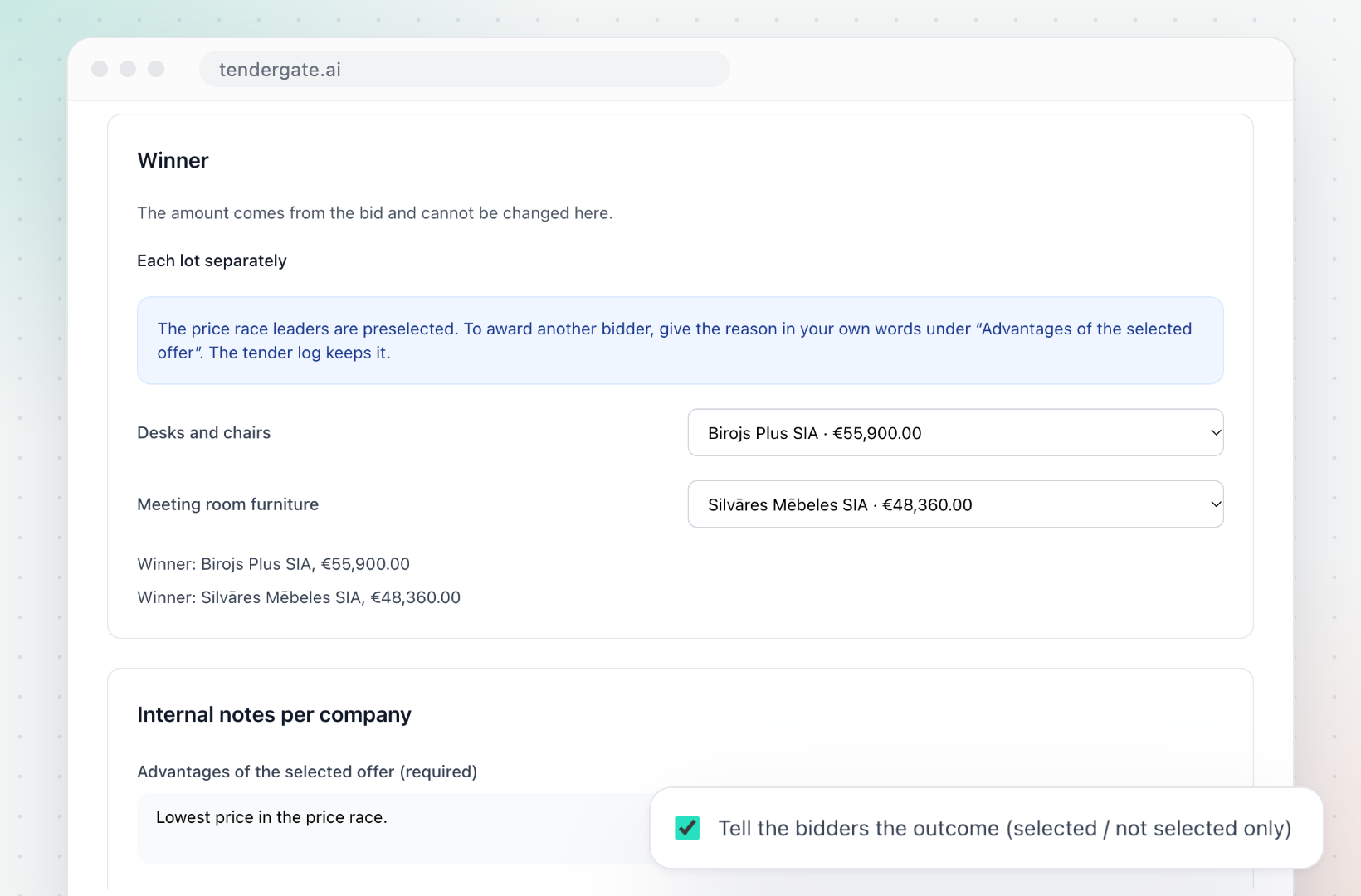
The race leaders are preselected. Choosing another bidder needs a reason, and the buyer decides whether bidders hear the outcome. Demo data.
4. Which mode to pick
The directive's test works for private buyers too: run a race only when the specification is precise enough to rank the bids automatically. If it is, and the suppliers' products are interchangeable, a one-stage race on price is fair and quick. If suppliers differ in ways that matter after delivery, use two stages, so quality sets the order before price moves it.
We expect more private buyers to choose on best value. Most still choose on price today, and the price race handles both.
Private companies can publish price requests and tenders on Tendergate with their own buying rules, and turn on a price race for any tender where bids arrive open. Publishing and bidding are free. AI work, such as proposing quality scores, uses credits.
Publishing and bidding are free.
Sources
- Directive 2014/24/EU, Article 35: Electronic auctions (European Parliament and Council, 26 February 2014; text as published on legislation.gov.uk). Full initial evaluation first, precise specifications, price-only or price-quality basis, a formula that includes the weighting of all award criteria, relative ranking for bidders, no disclosure of identities.
- Roughly 86% of Latvian tenders are decided by price. The official figure says 51%. (Tendergate, 19 August 2026). 58% of 6,752 calls for bids were price-only; where quality was weighed, price carried a median 80% of the score.
- The lowest price trap and The cheapest option is rarely the cheapest (Tendergate).
- Tendergate tender publishing, price race rules as released in November 2026: 2% default step (at least 1%), 60 seconds between rebids, prices only go down, no withdrawal during the race, a 10-minute extension after a late lead change (at most three), the low-price flag and the award reason log. Screenshots show invented demo data, not a customer tender.
We build AI for procurement, so it would be a little odd not to use it here. This post was written together: AI for the tireless reading and first drafts, people for the judgement, the corrections and the final yes.